Laboratory Hot Air Oven
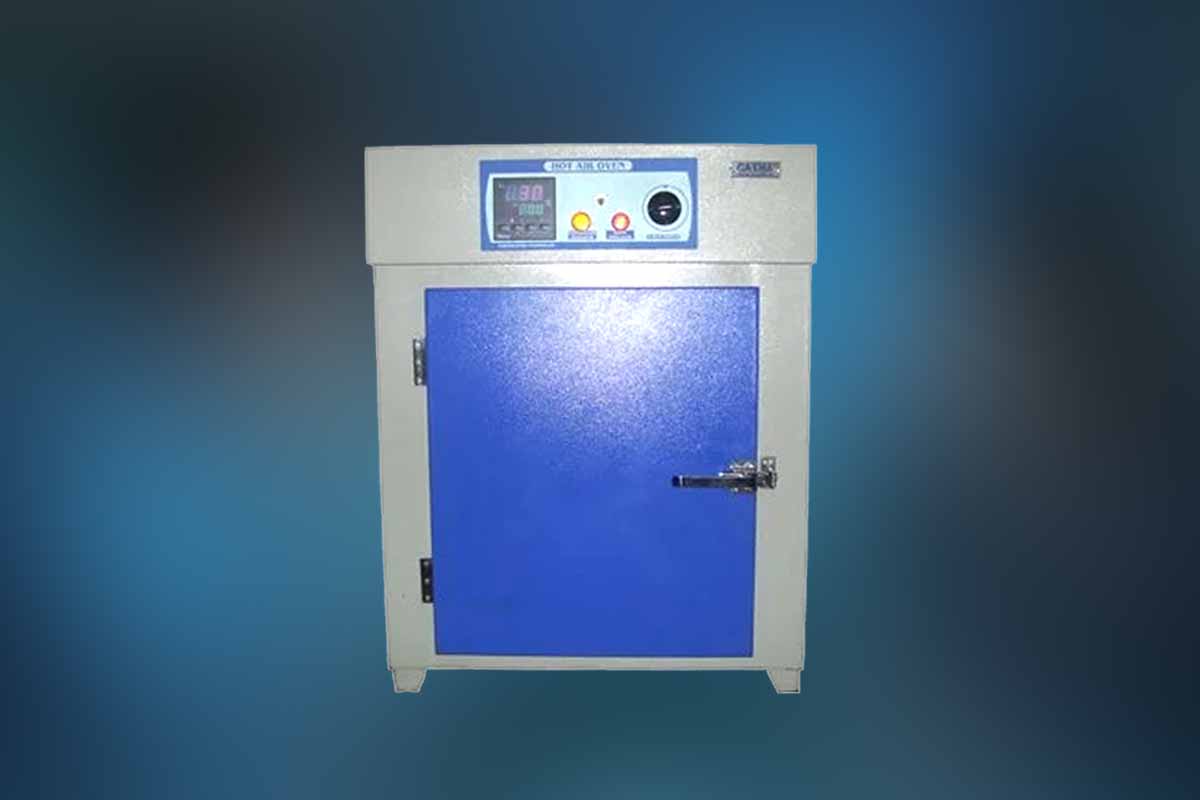
Laboratory Hot Air Oven
A Laboratory Hot Air Oven is a laboratory instrument used to sterilize, dry, and heat materials by circulating hot air at controlled temperatures. It works on the principle of dry heat sterilization, where high temperature kills microorganisms by oxidation and protein denaturation.
It is a device that employs heated air to heat, dry, or sterilize laboratory equipment such as glassware and metal instruments.
Working Principle of Laboratory Hot Air Oven
A Hot Air Oven works on the principle of dry heat sterilization, where hot air circulates uniformly inside the chamber to maintain a constant temperature for heating or sterilizing materials.
Principle“It functions through convection (and occasionally radiation), wherein electrically heated air is perpetually circulated to guarantee uniform temperature distribution within the oven.”
Working Mechanism
- Power Supply on electrical heating elements (usually made of nichrome) get energized.
- The heating elements produce heat, which warms the air inside the oven chamber.
- A fan (in forced air ovens) circulates the hot air uniformly, preventing temperature variations.
- A thermostat or digital controller maintains the set temperature (typically 50°C to 300°C).
- Sterilization / Drying Process continuous exposure to hot air causes oxidation of cellular components , Denaturation of proteins, Destruction of microorganisms and spores
- The chamber is insulated to prevent heat loss and maintain efficiency.
Common Sterilization Conditions
- 160°C for 2 hours
- 170°C for 1 hour
- 180°C for 30 minutes
Technical Specification of Laboratory Hot Air Oven
Display |
Digital |
Finishing |
Powder coated |
Tray Material |
SS Rods |
Working Temperature |
Ambient - 300 deg cel |
Chamber Material Outer |
MS |
Chamber Material Inner |
SS |
Features of Laboratory Hot Air Oven
- Uniform Heating - Ensures even temperature distribution throughout the chamber using air circulation.
- Temperature Control System - Digital or analog thermostat for precise temperature control (typically Ambient to 250–300°C).
- Stainless Steel Chamber - Inner chamber made of corrosion-resistant stainless steel for hygiene and durability.
- Double-Walled Construction - Inner stainless steel and outer mild steel body with insulation to reduce heat loss.
- Adjustable Shelves - Removable trays to place samples conveniently at different levels.
- Air Ventilation System - Adjustable air vents to release moisture and maintain dry heat conditions.
- Over-Temperature Safety Protection - Safety thermostat or thermal cut-off to prevent overheating.
- Uniform Air Circulation Fan (in forced air models) - Improves temperature accuracy and faster heating.
- Energy Efficient Insulation -Glass wool or mineral wool insulation for reduced power consumption.
- Transparent Viewing Window (optional) - Allows observation of samples without opening the door.
- Timer Function (in digital models) - Enables automatic operation for a set time period.
- Rust-Proof Exterior Finish - Powder-coated or epoxy-painted outer body for long life.
Applications of Laboratory Hot Air Oven
- Drying of Materials - Used to dry glassware, metal instruments, powders, and samples by removing moisture.
- Sterilization - Sterilizes laboratory equipment like glassware, forceps, petri dishes, pipettes, and metal tools using dry heat.
- Heat Treatment - Used for annealing, aging, and stress relieving of metal components and materials.
- Moisture Content Determination - Helps in determining moisture loss in samples by heating at controlled temperatures.
- Baking and Curing - Used for curing coatings, resins, adhesives, varnishes, and polymer materials.
- Testing of Materials - Applied in testing temperature resistance and thermal stability of materials.
- Chemical Experiments - Used for heating and drying chemicals that require uniform temperature without direct flame.
- Pharmaceutical Applications - Drying of pharmaceutical raw materials, powders, and granules.
- Food and Agricultural Testing - Used for drying food samples, grains, soil, and agricultural products for analysis.
- Quality Control Laboratories - Widely used in research, industrial, and quality control labs for consistent heating and drying operations.